When asked what issues concern them most, American voters speak clearly, and their priorities don't fit neatly into partisan boxes. A January 2026 nationwide poll of 1,000 registered voters shows that practical, bread-and-butter issues dominate, and that voters want the best solutions from across the political spectrum.
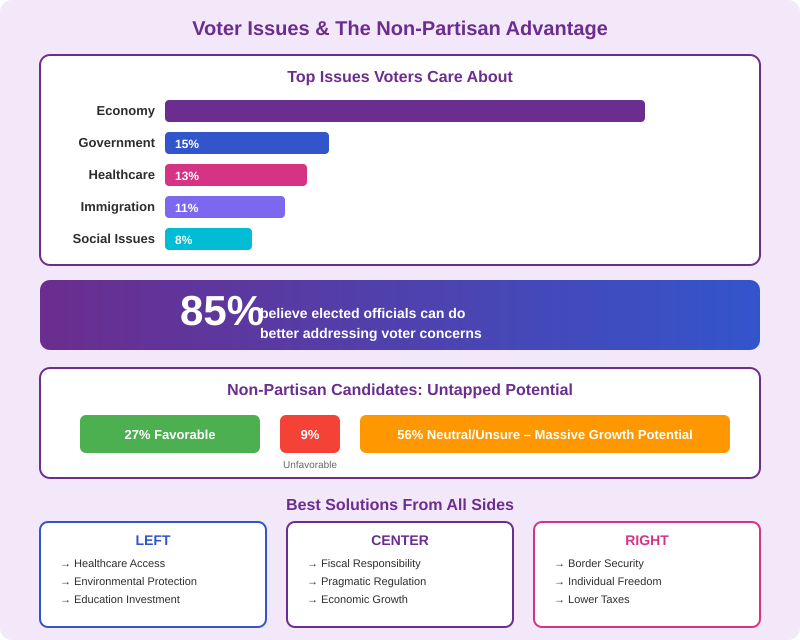
The economy dominates. 44% of registered voters cite the economy as the most pressing issue facing the country, with inflation and food prices accounting for 65% of economic concerns and job availability at 17%. Beyond the economy, voters name government issues (15%), health care (13%), immigration (11%) and social issues (8%).
Asked which issues should be prioritized for solutions, the picture shifts, with health care (27%), immigration (17%), Social Security (12%) and taxes (11%) rising in importance.
30% of Americans identify as moderate or centrist, the largest single group on the political philosophy scale, and 34% hold an overall moderate ideology. These voters aren't extreme; they're pragmatic.
39% of registered voters say they will support candidates who prioritize bipartisan cooperation. And asked to evaluate the "representation" argument, that most Americans don't fit into red or blue boxes, 12% called it the most compelling case for nonpartisan candidates.
Voters show flexibility across multiple issues, including taxes (13%), the environment (12%), immigration (12%) and health care (9%). While 26% say they are unwilling to compromise on any issue, 74% are open to solutions that don't fit partisan talking points.
The bottom line: voters want elected officials who will do their jobs better (85%), are willing to compromise on most issues (74%) and represent the complex reality of modern America rather than extreme ideological positions.
Only 27% currently view nonpartisan candidates favorably, but 56% remain neutral or unsure. Many voters simply haven't formed a view yet. What they have made clear is what they want from government: a strong economy with controlled inflation, accessible and affordable health care, a secure border, and leaders who rise above partisan gridlock.
Independent Center Voice 2026 Nationwide Online Survey of 1,200 adults, including 1,000 registered voters. Field dates: Dec. 30, 2025–Jan. 1, 2026. Total adult margin of error: ±2.83%. Registered voter margin of error: ±3.1%.