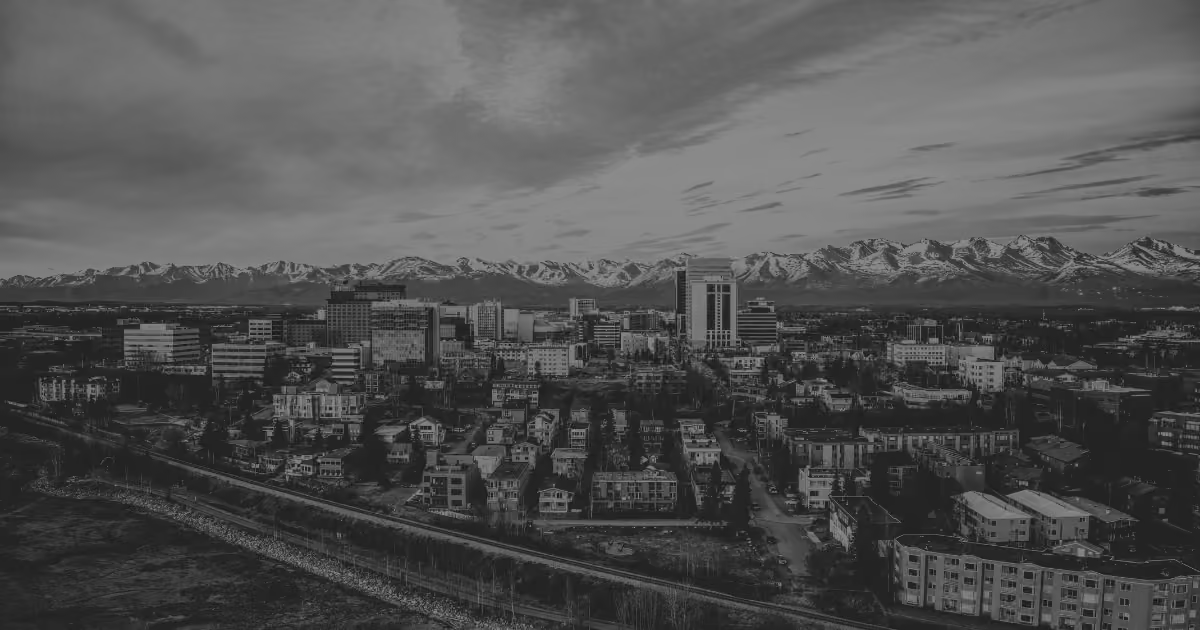
Alaska's August 18 top-four primary narrowed the field to four candidates for the November 3 ranked-choice general election: Republican incumbent Nick Begich, independent Bill Hill, Democrat Eric Hafner, and Libertarian Jim McDermott.
Alaska sends one member to the U.S. House. That seat covers 663,000 square miles and the lives of more than 740,000 people—from Utqiaġvik to Ketchikan. In 2024, it was decided in three rounds of ranked-choice voting. In 2022, it produced one of the biggest political upsets in the country. In 2026, it's already a four-way race with no clear favorite. There's one number that frames everything else: roughly two-thirds of Alaska's voters belong to no political party at all. Unaffiliated voters outnumber registered Republicans and Democrats by more than two to one. Alaska is, by registration, the most independent-leaning state in the country—and its election system was built to reflect that.
For decades, Alaska's at-large seat was a one-person show. Then 2020 changed the rules, 2022 produced an upset, 2024 went to ranked-choice round three—and 2026 looks like none of them.
Alaska sends one member to the U.S. House. That seat covers 663,000 square miles and the lives of more than 740,000 people—from Utqiaġvik to Ketchikan. In 2024, it was decided in three rounds of ranked-choice voting. In 2022, it produced one of the biggest political upsets in the country. In 2026, it's already a four-way race with no clear favorite. There's one number that frames everything else: roughly two-thirds of Alaska's voters belong to no political party at all. Unaffiliated voters outnumber registered Republicans and Democrats by more than two to one. Alaska is, by registration, the most independent-leaning state in the country—and its election system was built to reflect that.

Alaska At-Large, 2012 (lost); 2014 (lost); 2016 (lost)
Fairbanks resident and retired U.S. Air Force master sergeant; former director of the Fairbanks Small Business Development Center.

Multiple federal races across several states, 2018–2024
Frequent candidate for federal office across multiple states; currently in federal prison.

First-time candidate, 2026
Dena'ina Athabascan from Naknek, Alaska; commercial fisherman in Bristol Bay since age 12; former construction union member; spent over 25 years as a teacher, principal, and superintendent and was named Alaska's Superintendent of the Year in 2023

Elected to U.S. House, 2024
U.S. Representative for Alaska's at-large district; born in Anchorage and raised in Chugiak; graduate of Baylor University and Indiana University; background in business, technology, and entrepreneurship, including prior work with Ford Motor Company and Alaska startups
Alaska's at-large seat sits at the intersection of issues most other House seats never touch. The list below combines what Alaska voters say matters most—drawn from voter file data and Alaska-specific sentiment tracking—and what the next member of Congress will actually be voting on.
Sockeye salmon. The Pebble Mine debate. ANWR. The collapse of Yukon and Kuskokwim salmon runs. Alaska's resource and federal-lands debates run through the next member of Congress more than any other state's.
Hunting, fishing, and gathering aren't hobbies in much of Alaska—they're the food supply. Second Amendment rights are the second-most-flagged issue in the Alaska voter file. These aren't abstract debates here.
Groceries, fuel, healthcare, and housing—affordability is the top concern voters in Alaska bring up first, especially in rural villages where goods cost three times the mainland average.
How the Permanent Fund is managed, who benefits, and whether the dividend reflects what was promised—these come up in nearly every serious Alaska political conversation, regardless of party.
Term limits, a ban on congressional stock trading, and closing corporate tax loopholes poll at record highs and cross every demographic in Alaska. Distrust of career politicians runs at roughly 80% cross-partisan agreement.
Alaskans pay some of the highest broadband and mobile bills in the country, despite massive federal subsidies flowing to a small number of providers. Cross-partisan frustration runs at 85%+ in recent Alaska sentiment tracking.
Roughly two-thirds of Alaska's voters are registered Unaffiliated—more than R and D registrations combined, by more than two to one.
That's not a fringe. That's the majority of Alaska's voters, by a wide margin. And in 2020, those voters did something the rest of the country is still catching up to: they changed the rules of the game. By passing Ballot Measure 2, Alaskans opened their primaries to all candidates regardless of party—and made every general election use ranked-choice voting. The result has been some of the most competitive, least scripted federal elections in the country. The system rewards candidates who can build broad coalitions, and it gives voters real choices instead of a binary. There's a second pattern worth naming. In Alaska sentiment tracking across the political spectrum, distrust of career politicians runs at roughly 80% cross-partisan agreement. Left, center, and right Alaskans disagree about plenty—but they share a strong sense that the establishment doesn't reflect Alaskan realities. That cross-partisan ground is unusual, and it's part of why Alaska's elections look the way they do. Independent Center exists to make sure independent voters across the country know what's possible. We track voting-system reforms like Alaska's. We educate independent voters about their options. And we push for the structural reforms—open primaries, ranked-choice voting, congressional accountability—that put unaffiliated voters back at the center of American democracy.
