Idaho's closed Republican primary is over, but the November ballot has four candidates: the Republican incumbent, a Libertarian, and two independents. If you're one of Idaho's 270,000-plus unaffiliated voters, the general election is where your vote counts. Here's who's running and what's at stake.
Idaho is one of the most reliably Republican states in the country. A Democrat hasn't won a U.S. Senate race here in more than half a century, Republicans hold supermajorities in the legislature, and the incumbent won his last race by roughly 30 points. In a state like this, the contest most people pay attention to—the closed Republican primary—is over by May, and a quarter-million unaffiliated voters never get a say in it. That makes the November general election the one moment when every registered Idahoan, regardless of party, is choosing from the same full ballot. This page lays out that choice. We don't tell you the race is close; we tell you it's yours.
Idaho's closed primary already decided who Republicans nominated. The general election in November is the first time every registered Idahoan—including the quarter-million registered with no party—sees the same ballot.
Idaho is one of the most reliably Republican states in the country. A Democrat hasn't won a U.S. Senate race here in more than half a century, Republicans hold supermajorities in the legislature, and the incumbent won his last race by roughly 30 points. In a state like this, the contest most people pay attention to—the closed Republican primary—is over by May, and a quarter-million unaffiliated voters never get a say in it. That makes the November general election the one moment when every registered Idahoan, regardless of party, is choosing from the same full ballot. This page lays out that choice. We don't tell you the race is close; we tell you it's yours.
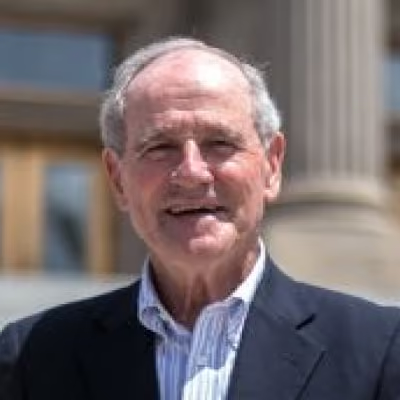
U.S. Senate: 2008, 2014, 2020; Idaho Governor (2006–07); Lieutenant Governor (2003–06, 2007–09)
U.S. Senator since 2009; chair of the Senate Foreign Relations Committee; former Idaho governor and lieutenant governor

First run for office, 2026.
Spent childhood summers on a family ranch in Christmas Valley, Oregon, and attended junior high and high school in Moscow, Idaho. Worked in the technology industry early in her career at WordPerfect and Novell.

Libertarian candidate for Idaho's 1st Congressional District, 2024.
Grew up in suburban Denver, Colorado; worked in video game development before moving to Idaho's Treasure Valley in 2020; active with the Libertarian Party of Idaho.

Idaho House, District 16B: appointed 2024; elected 2024
Army veteran and former tank commander; grew up on a family farm and spent over 20 years in senior technology leadership roles at T-Mobile, Hewlett-Packard, and several startups. Served in the Idaho House of Representatives as a Democrat from February 2024 until resigning in June 2025 to run for U.S. Senate as an independent.
Based on voter file data and our 2026 Tuned In polling, here are the issues Idaho voters say will shape their vote. We don't tell you what to think about them. We do tell you they matter.
By far the most-flagged issue in the Idaho file—more than half of voters carry it. Federal border policy and immigration enforcement are squarely on the Senate's docket.
Wages, prices, and a housing market that has climbed sharply as Idaho has grown—and what federal policy does or doesn't do about it.
Second Amendment questions and the broader Idaho preference for limited government in private life.
A defining Idaho issue across the spectrum: whether federal public lands stay public, and how they're managed.
Term limits, money in politics, and congressional stock trading—the structural-reform questions that cut across party lines.
Federal spending, the debt, and the tax code—consistently among the top concerns in the Idaho voter file.
272,809 Idahoans are registered with no party at all—more than double the number registered as Democrats.
Idaho registers voters by party, and the numbers tell a story the headlines miss. There are 272,809 Idahoans registered with no party at all—more than double the number registered as Democrats. Unaffiliated voters are the second-largest registration bloc in the state, and in a closed-primary system they're the ones most often shut out of the contest that decides things. The general election is the one place that imbalance disappears: every registered Idahoan, of every affiliation, gets the same ballot and the same say. The most consequential thing an independent-minded Idahoan can do is make sure they're registered and that they show up for it. Independent Center exists for voters like you. We poll independent voters so their views get counted. We help independent voters understand their options. And we push for the reforms—open primaries, fair ballot access, government accountability—that put unaffiliated voters back at the center of the process.
