Indiana will elect a new Secretary of State on November 3, 2026, in an open race for an office Republicans have held since 1994. Republican Max Engling defeated incumbent Diego Morales for the nomination at the party’s June 20 convention, and Democrat Beau Bayh was nominated at his party’s convention earlier that month. They’ll face Libertarian Lauri Shillings and independent Greg Ballard, a former Indianapolis mayor running under the Lincoln Party label.
The Secretary of State is Indiana's chief election officer. The office certifies elections, oversees the statewide voter file, regulates campaign and business filings, and sits at the center of how every Hoosier's vote is counted. It is also, historically, a partisan office: Indiana Secretaries of State have endorsed, fundraised for, and donated to candidates who appear on the very ballots they oversee. In 2026, that arrangement is itself one of the questions on the ballot—because at least one candidate is running specifically to change it. Most voters never think about this office until something goes wrong. This is the year to look at it before that happens.
The Secretary of State is Indiana's chief election officer. The office certifies elections, oversees the statewide voter file, regulates campaign and business filings, and sits at the center of how every Hoosier's vote is counted.
The Secretary of State is Indiana's chief election officer. The office certifies elections, oversees the statewide voter file, regulates campaign and business filings, and sits at the center of how every Hoosier's vote is counted. It is also, historically, a partisan office: Indiana Secretaries of State have endorsed, fundraised for, and donated to candidates who appear on the very ballots they oversee. In 2026, that arrangement is itself one of the questions on the ballot—because at least one candidate is running specifically to change it. Most voters never think about this office until something goes wrong. This is the year to look at it before that happens.

Indiana's 5th Congressional District, 2024 (Libertarian nominee)
Creative director in the University of Indianapolis' marketing office; Hamilton County Libertarian Party chair since 2021. Carmel resident and lifelong Hoosier focused on bringing a nonpartisan, service-oriented approach to state government.

Indiana's 5th Congressional District Republican primary, 2024 (lost)
Senior advisor to U.S. Senator Jim Banks; former House Administration Committee staffer, where he worked on federal election legislation, and later member services director for then-House Speaker Kevin McCarthy. Won the 2026 Republican nomination at the June 20 state convention, defeating incumbent Secretary of State Diego Morales. Cicero resident; graduate of Indiana University–Purdue University Indianapolis with a master’s degree from the U.S. Naval War College.
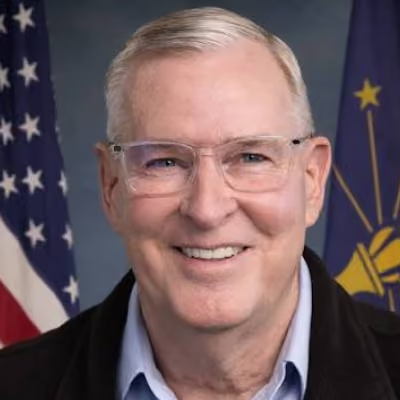
Mayor of Indianapolis, 2007 (won); 2011 (won)
Former two-term Republican mayor of Indianapolis (2008–2015); retired U.S. Marine Corps lieutenant colonel. Running under the newly formed Lincoln Party label, Ballard qualified for the November ballot after the Indiana Election Division verified 40,361 valid signatures, above the 36,943 required.

First-time candidate, 2026
Attorney and seventh-generation Hoosier; son of former Indiana Governor and U.S. Senator Evan Bayh. Served as a U.S. Marine Corps infantry officer, rising to the rank of captain; deployed to Europe in support of the U.S. response to the Russian invasion of Ukraine. Graduate of Harvard University and Harvard Law School.
The Secretary of State doesn't write laws on the issues that dominate the headlines. What it controls is quieter and arguably more fundamental: whether your election runs cleanly, who gets onto the ballot, and whether you can trust the count. Here's what's genuinely at stake.
The central question of this race: whether the official who administers elections should also endorse, fundraise for, and donate to candidates on the ballots they oversee.
Maintaining the statewide voter file, securing election systems, and keeping registration rolls both accurate and accessible all run through this office.
The Secretary of State also oversees business registrations, securities regulation, and notaries—the administrative plumbing of Indiana's economy.
This office sits at the center of ballot-access rules—including why a major-party nominee is chosen at a convention while an independent must gather tens of thousands of signatures.
The Secretary of State is Indiana's chief election officer, overseeing how votes are cast, counted, and certified in all 92 counties. This is the office on the ballot.
Indiana voters across the spectrum say they want government they can audit. This office sets how openly election data, certifications, and campaign filings are reported.
Indiana doesn't register voters by party. There's no box on your registration that says Democrat or Republican. All 4.7 million registered Hoosiers are, in the state's own records, independent.
You are not locked into a team. You can look at every candidate on this ballot on the merits and decide for yourself. That's exactly what this page is built to help you do. Independent Center exists for voters like you. We poll independent voters so their views get counted. We educate independent voters about their options. And we push for the structural reforms—open primaries, fair ballot access, transparent administration—that keep unaffiliated voters at the center of American democracy.
