Every poll this year told the same story. Jobs and the economy came first. Groceries were the single biggest strain on household budgets, named by 61% of registered voters. Then health care, gas, rent. Affordability, affordability, affordability.
All true. And almost useless for explaining how anyone voted.
Affordability was the weather. Everyone lived in it: voters who went left, voters who went right, and voters who stayed home. A grievance that universal can't explain why people behaved differently. Worse, most voters privately doubt it can be fixed. Nobody seriously expects a new majority in Congress to make beef cheaper. An issue that is both universal and hopeless sets the mood. It doesn't pull the lever.
What pulled the lever was narrower and angrier: the belief that the economy and the government are rigged for big companies and the politically connected, and that both parties are in on it. That belief does two things affordability can't. It names a villain. And it points to a fix.
It also had something the price of eggs never had: a fresh piece of evidence landing in voters' feeds every week of 2026.
The Independent Center spotted this in the spring, when it was still a sideshow to the affordability conversation.
The tell wasn't volume. Anti-Trump and anti-Republican content always runs hot in the big political forums. The tell was which stories broke out, and the words people used about them. On 9 May, r/politics pushed a story about a $6.9 million no-bid contract for the president's "pool guy", awarded under an "urgent" exemption, past 24,000 upvotes. Our analysis tagged the thread's dominant theme as cronyism. Not incompetence. Not ideology. Self-dealing.
It wasn't a one-off. The same weeks brought the shadow-docket memo leak (19 April), which commenters read as proof that an unaccountable institution was working in the dark, and a jury verdict that Ticketmaster is an illegal monopoly (15 April), a story with no partisan angle at all that still drew nearly 30,000 upvotes on the strength of one idea: the game is fixed.
The most important moment was when the both parties frame showed up inside a strongly partisan space. On 1 May, Jon Stewart calling Democratic leadership and the DNC "lost" drew 28,500 upvotes in r/politics. Our analysis scored that thread's establishment stance at −0.6: a left-leaning forum turning on its own leadership. Four weeks later, a Republican congressman vowing to name names from the Epstein files scored −0.8. The anger was no longer pointed only across the aisle. It was pointed upward.
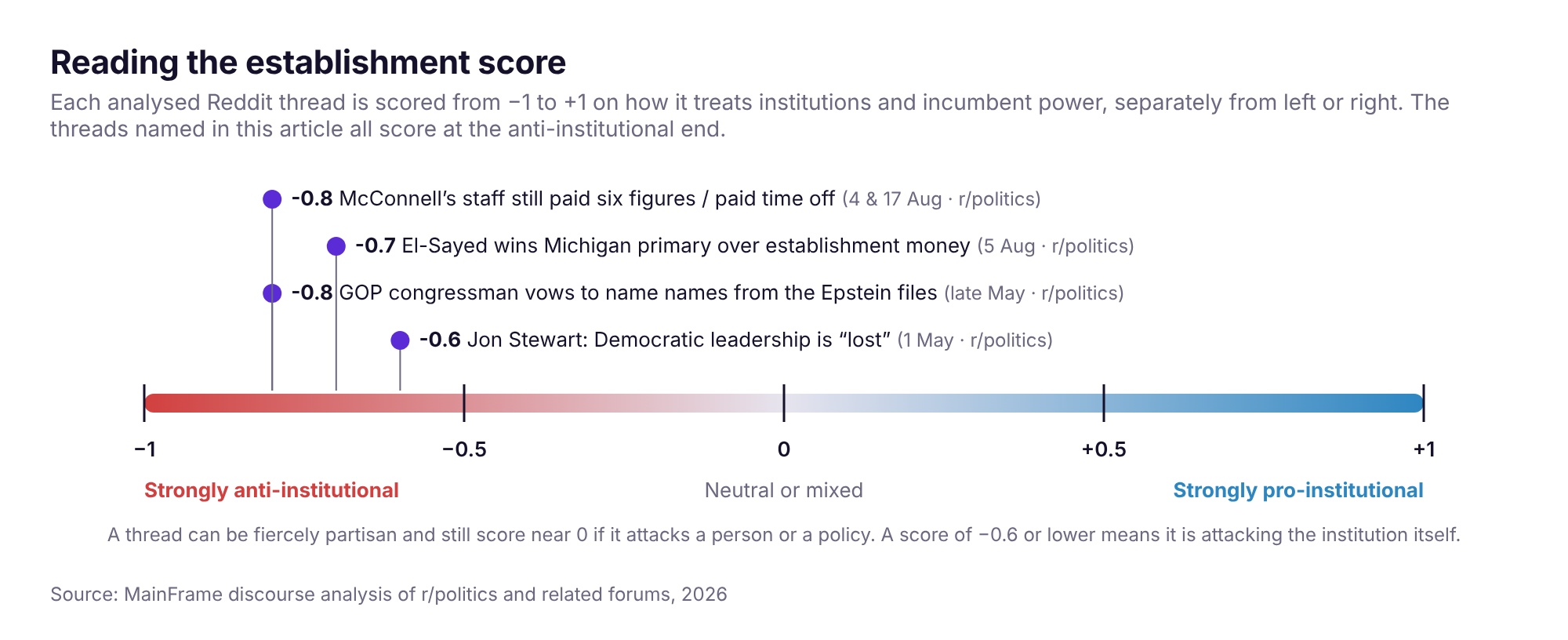
Already visible in the same window: the first cracks in affordability as a political argument. "Republicans Don't Want to Talk About Gas Prices Anymore" (11 May) wasn't a story about prices. It was a story about price talk being insincere: a weapon picked up and dropped for advantage. Voters were learning to hear affordability talk as a performance.
By July and August the frame had hardened. Critically, its targets were now on both sides.
The McConnell stories were the clearest case. "Missing Mitch's Staff Is Still Raking in Six-Figure Salaries" (4 August) and "Mitch McConnell is getting more paid time off than women who give birth" (17 August) both scored −0.8 on establishment stance. Neither is really about McConnell. Both are about a protected class living under rules that don't apply to anyone else. That is the emotional core of every rigged-system complaint, and these two fused it directly to a kitchen-table one.
The summer's biggest cronyism story did the same thing: "Texas Politicians Slowly Realize Elon Musk Hijacked Billions In Taxpayer Broadband Grants" (31 August). Public money, private beneficiary, politicians either complicit or pretending not to know with an election coming.
And in the state races, voters acted on it. Abdul El-Sayed's Michigan primary win (5 August) was read by his own supporters as a grassroots defeat of establishment and corporate money; the thread scored −0.7. In the press, El-Sayed was openly courting independents and Republican voters with that same anti-insider critique (Tampa Free Press, 11 August). The pitch was crossing party lines in practice, not just in theory.
The structural complaint reached the mainstream press too. "Florida's closed primaries leave more than 3M voters out of partisan races" (News 13, 18 August). Arizona's Democratic governor picked a Republican-turned-independent as her running mate (AP, 11 August). Minnesota's primary was covered as a fight between party wings, not a contest of ideas.
Meanwhile affordability kept getting swallowed by the rigging story instead of standing on its own. "Your deadbeat president is never giving you $5,000" (10 September) looks like an affordability story. In substance it is a story about being lied to by someone who never meant to deliver.
In the final stretch the frame stopped being one storyline among many and became the lens for all of them.
Notice what is missing from the top of the autumn feed: a sustained, standalone affordability argument.
Cost of living was still there, but almost always as evidence in a larger charge. Diesel at $5.85 a gallon as the price of a war. White House renovations set against household budgets. Cancelled health and education funds as a theft of Congress's power of the purse. Affordability had been demoted from argument to exhibit.
This is where the national numbers stop being suggestive and become decisive.
Among independent-minded voters — everyone who is not a Strong Democrat or a Strong Republican, 55% of adults — the diagnosis is remarkably consistent:
Independent-minded voters share a diagnosis of what's wrong: parties put themselves first, nobody listens, and the economy works for insiders. — MainFrame data-science analysis, EXP-06
But the single most important number in the whole dataset is the answer to a different question: who did it?
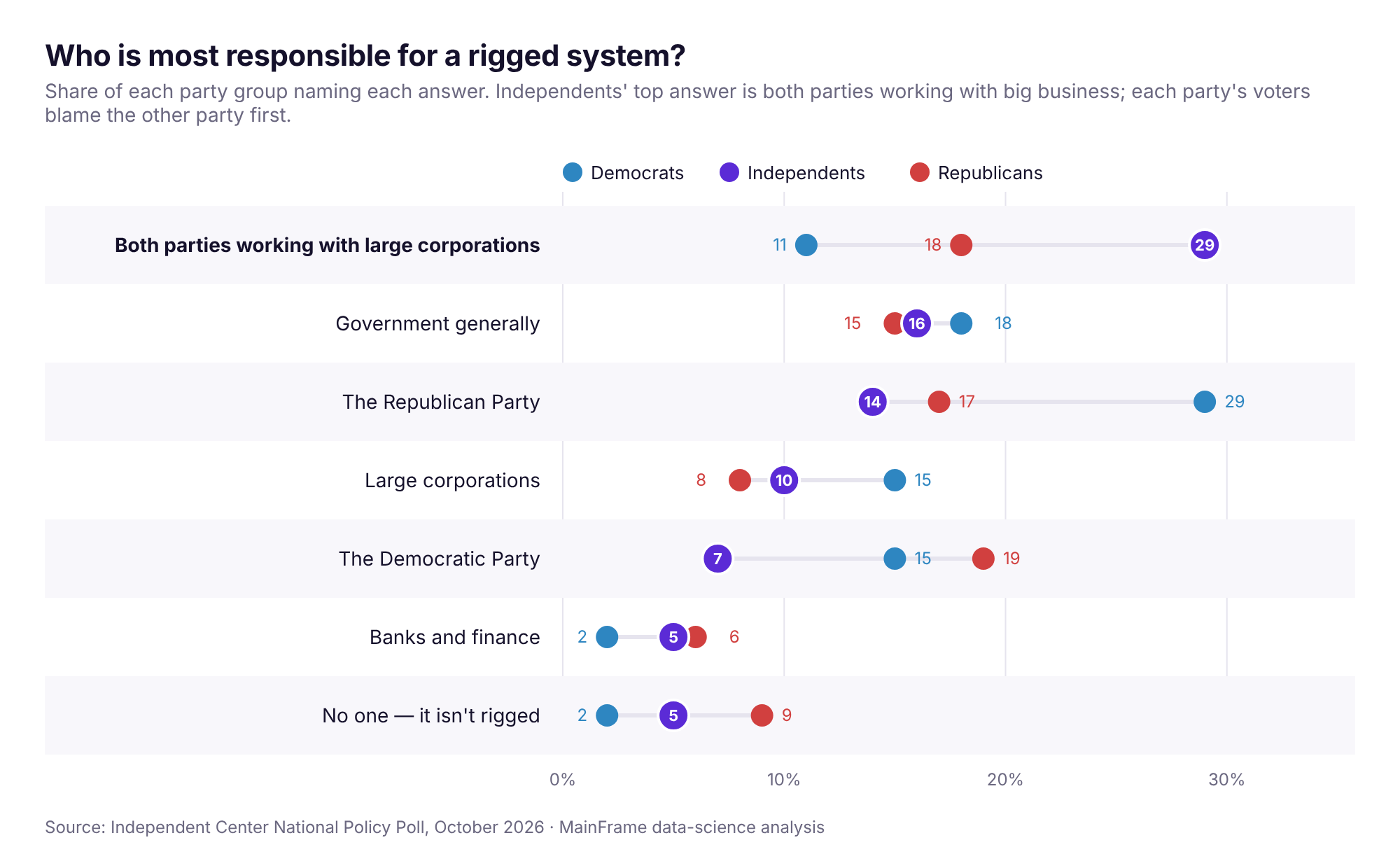
Democrats blame Republicans. Republicans split three ways. Independents give a different answer entirely. Their top choice is "both parties working together with large corporations" at 29% — 31% among pure independents — nearly double their next answer, "government generally", at 16%.
Independents frame the problem as collusion, not ideology. — EXP-20
That is the trigger, isolated. It is not a left-wing critique or a right-wing one. It is a structural one, and the voters who decide elections hold it most strongly.
It shows up in economic life too. Asked what most gets in the way of small business, big companies using political influence to shut out competition is the most-named obstacle overall (28%). Independents rank it first (30%), as do business owners (32%). It beats tariffs among independents (30% to 20%), Republicans (24% to 15%) and business owners (32% to 20%).
The obstacle that unites is cronyism. — EXP-19
Crucially, this is not an anti-market mood. 54% of all adults say the economy is rigged, but only 15% want to replace capitalism. A quarter of adults (26%) back capitalism and say it's rigged at the same time, and that group is about the same size among Democrats (24%), independents (28%) and Republicans (27%). As the analysis puts it: "'Rigged' doesn't mean anti-market."
And the remedies aren't partisan at all.
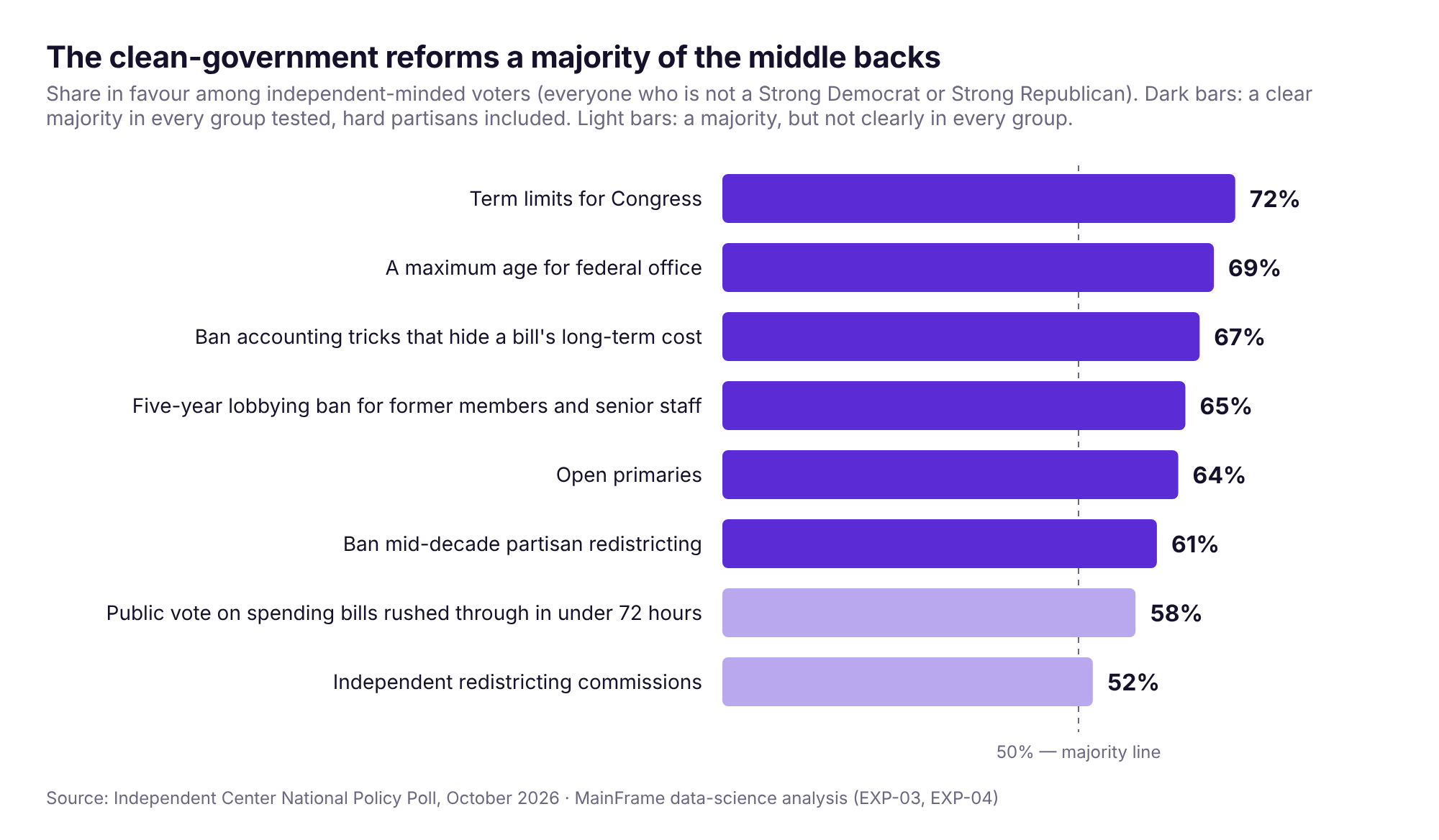
The stock-trading ban is the standout. Both parties share independents' answer on it. Support is a flat line from Strong Democrat to Strong Republican, unlike trade, taxes or health care. And it is one of the four questions independents are most united on, more united than either party. At the topline, 76% of adults would ban members of Congress from trading individual stocks and 71% back a five-year lobbying ban for former members and senior staff.
Most of the reform agenda isn't a partisan question at all. The middle agrees on it, but so do the hard partisans. — EXP-04
Underneath it all sits a vacuum. The federal government finishes last on trustworthiness in every single group (8–20%); local government finishes first everywhere (28–37%). And 45% of independent-minded voters — half of pure independents — can't name any level of government they trust most, against roughly a quarter of strong partisans.
The AP Voter Poll, the survey of about 80,000 voters that the Associated Press and the television networks now use in place of a traditional exit poll, asked voters to pick the single most important issue facing the country. The economy came first, named by 39%. And those voters split down the middle: 52% Democratic, 46% Republican. The issue everyone agreed mattered most produced no verdict at all.
The verdict came from the second-largest group. A third of voters, 33%, said the most important issue was the state of democracy, and they voted 79% to 20% Democratic. No other issue of comparable size broke that hard. Immigration voters went 89% Republican, but they were 14% of the electorate; healthcare voters went 67% Democratic, but were 8%.
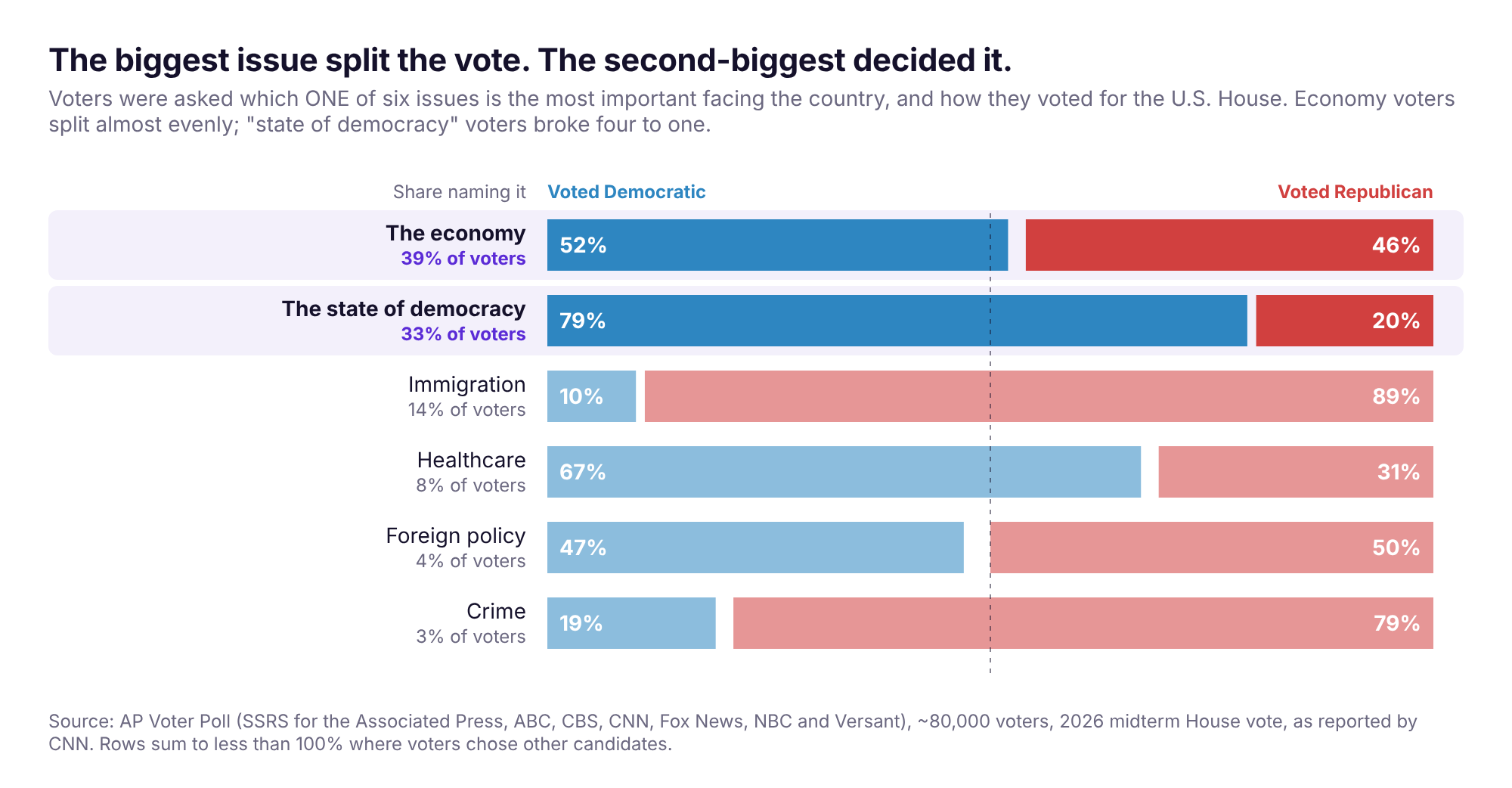
"The state of democracy" is a broader label than "rigged", and it will have meant different things to different voters. But it is the survey's closest proxy for the complaint this article has traced all year: that the institutions are run for the people inside them. A third of the electorate said that was the biggest problem in the country, and four in five of them voted the same way. That is what a trigger looks like.
Put the two grievances side by side and the difference is obvious.
Affordability failed as a trigger precisely because it was the consensus issue. When both sides promise to fix the same thing and neither is believed, the issue stops sorting voters.
The rigging frame does the sorting instead. It is the mechanism that turns general economic misery into a specific verdict about specific people. Prices made voters angry. Cronyism told them who to be angry at, and gave them something to do about it on a ballot.
Three things follow.
1. The message that travels is anti-cronyism, not anti-regulation or anti-tariff. "Cut regulation" reads as Republican. "End tariffs" reads as Democratic. "Rules written for incumbents, markets closed to newcomers" is the one economic frame that independents, Democrats and business owners all put at or near the top.
2. Don't mistake "rigged" for radical. The people most convinced the system is rigged are overwhelmingly not asking to replace capitalism. They are asking for it to be un-rigged. Pitching them structural upheaval misreads the room as badly as pitching them the status quo.
3. The reform agenda is the asset. Term limits, lobbying bans, honest budgeting, an end to mid-decade gerrymanders, a stock-trading ban that polls the same from one end of the spectrum to the other. In a year when trust in the federal government finished last in every group measured, these are the only promises with a built-in credibility advantage, because they cost the person making them something.
Affordability was the backdrop of 2026. Cronyism was the trigger. Campaigns that can only talk about the first will keep being surprised by elections decided by the second.
Polling. Findings on independent-minded voters, the "who rigged it" breakdown, the cronyism obstacle and the reform chart: Independent Center National Policy Poll, October 2026; analysis by MainFrame's data-science team (EXP-03, EXP-04, EXP-06, EXP-11, EXP-13, EXP-19, EXP-20). Topline figures (76% stock-trading ban, 71% lobbying ban, 61% naming groceries as the top budget pressure): Independent Center National Policy Poll. Fielded 1–6 October 2026 by The Bullfinch Group for the Independent Leadership Council and the Independent Center; 1,200 U.S. adults, 1,000 registered voters. Results are unweighted and quota-balanced before fielding; margin of error ±2.8 points on the full sample. Soft-leaner subgroups number 66–96 respondents and should be treated as colour, not headline.
Election-day survey. AP Voter Poll, conducted by SSRS for the Associated Press, ABC, CBS, CNN, Fox News, NBC and Versant: about 80,000 registered voters, October 19 to November 3, 2026. House vote by most important issue facing the country, as published by CNN. Rows do not sum to 100% where voters chose other candidates or did not answer.
Discourse and press. Reddit threads, dominant-narrative tags and establishment stance scores drawn from r/politics, r/AmericanPolitics, r/PoliticalDiscussion, r/Askpolitics, r/centrist, r/moderatepolitics and r/Economics, January–November 2026. The establishment stance score is described in the box in the Spring section. Press items from Washington Post, Reuters, TIME, AP, Detroit News, Tampa Free Press and News 13 via the affordability, election-reform and independent-candidate monitors.
A note on language. The poll never uses the word "corruption". Its terms are rigged, cronyism, collusion, the politically connected and put their own interests ahead of the country's. Those are the words used wherever a number is cited here; "corruption" appears only as editorial framing.