Alaskans have voted time and again to remind the political establishment that Alaska’s elections belong to its people. And by defending their electoral system at the ballot box, they have proven they mean it every single time. With the recent defeat of Ballot Measure 2, voters once again rejected an effort to repeal the state's ranked-choice voting system and open primaries. In doing so, they protected a structure fundamentally designed to serve the electorate rather than partisan gatekeepers.
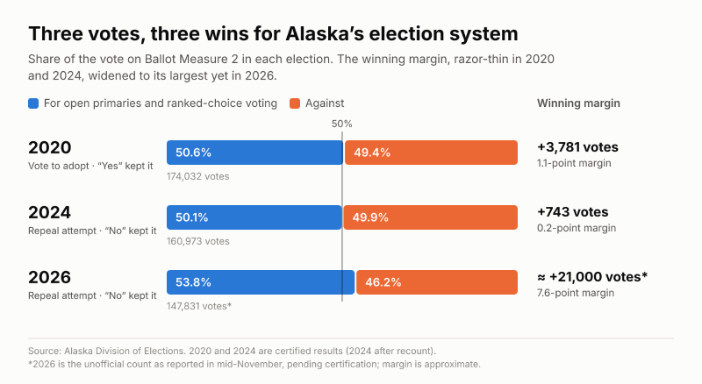
When the system was first adopted in 2020, more than 174,000 Alaskans voted in favor of Ballot Measure 2, passing the initiative by a margin of 50.6% to 49.4%. Four years later, opponents of the system tried to repeal it. Over 160,000 Alaskans voted "No" on the 2024 repeal measure, narrowly defeating it and preserving the system by a 50.1% to 49.9% margin. This year, according to unofficial results still awaiting certification, more than 147,000 voters once again cast their ballots to protect ranked-choice voting, rejecting the 2026 repeal effort by an even larger margin of 53.8% to 46.2%. Across three separate elections, hundreds of thousands of Alaskans have consistently turned out to defend a system that works for them.
To understand why this system matters, you only have to look at the makeup of the state. In Alaska, roughly 63% of voters register as independent or non-partisan. Under the old system of closed or semi-closed party primaries, the vast majority of the state’s electorate was often sidelined, forced in November to choose between candidates selected by a highly partisan minority. The current system finally reflects the reality of the independent voter. It opens the doors, allowing every voter to weigh in on every candidate, regardless of party affiliation.
Ranked-choice voting fundamentally changes the incentive structure of a campaign so that it works for the people. When candidates know they need a true majority to win outright, they can no longer afford to retreat to their partisan corners and pander only to their most extreme base. They have to get out and earn every single vote. If a candidate cannot be a voter's first choice, they must work to be a respected second or third choice.
This requirement fosters campaigns focused on consensus, broad appeal, and genuine dialogue over divisive rhetoric. It means politicians have to listen to the 63% of independents just as closely as they listen to their party loyalists. It ensures that the candidate who ultimately takes office is the one who represents the broadest swath of the community.
The defeat of Measure 2 is more than just a procedural victory; it is a mandate. It confirms that when you give power back to the voters, they recognize its value and refuse to surrender it back to the establishment. For the independent majority, this system works. It forces candidates to be accountable to the whole state, reminding them that their true bosses are the people of Alaska.