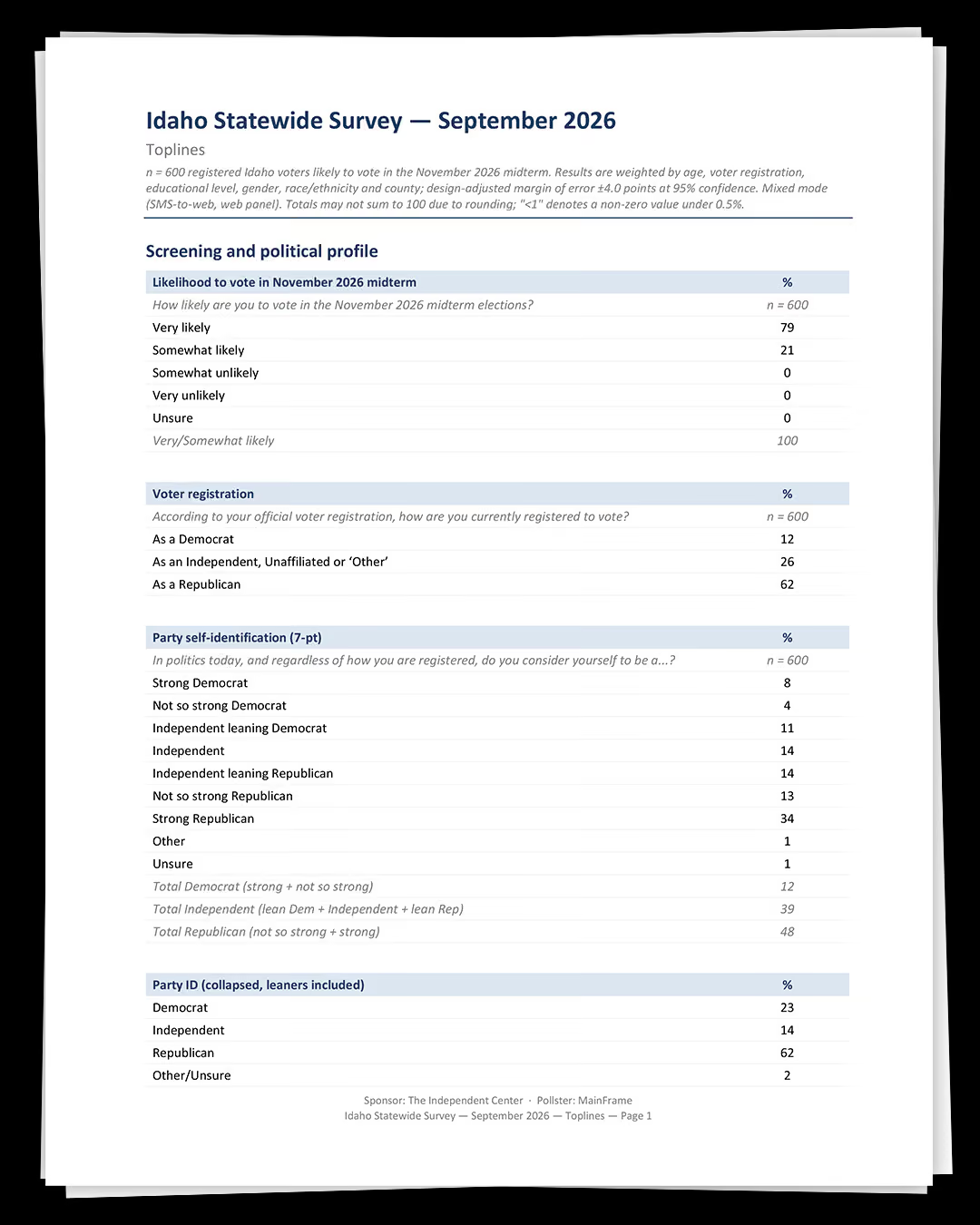
Online survey of U.S. adults conducted by The Bullfinch Group for ILC and the Independent Center, n = 1,200, of whom 1,000 are registered voters. Results are unweighted (pre-field flex quotas balanced to census and data universe targets on gender, age, race/ethnicity, partisanship, education level and geography). Margin of error ±3.1 points (registered voters) and ±2.8 points (adults) at 95% confidence. Fielded Oct. 1–6, 2026. Totals may not sum to 100 due to rounding. Figures below are for all adults unless noted.
Americans are far less divided on solutions than the two parties suggest. On energy, immigration, technology, spending and government reform, majorities land on practical, common-sense positions rather than either party's extremes. 37% of adults identify as independents, including those who lean toward a party, more than identify as Democrats (31%) or Republicans (30%), and 66% place themselves somewhere in the moderate range.
Americans want representatives who work across the aisle. 36% say the best candidate to represent them in Congress is one who works and votes with both Republicans and Democrats, more than choose a candidate aligned with Democrats (28%) or Republicans (23%). When Congress fails to get things done, 43% say both parties put their own interests ahead of the country's. An independent candidate not affiliated with either party is viewed favorably by 49% and unfavorably by 25%.
Many feel unheard, and see independents as a way to change that. 51% say their voice is not being heard in Washington by their elected representatives. 45% say three to five independent members holding the balance of power in Congress would force the parties to reach agreements, compared with 29% who say they would be shut out. And 44% say independent and third-party candidates should get the same ballot access, debate access and campaign-finance treatment as the two major parties.
70% want government to actively expand energy supply: 39% favor supporting cleaner energy through tax credits and standards, and 31% want all energy sources treated equally with projects approved quickly. 30% prioritize strong environmental review even when it slows development. Asked for the top priority, 33% say lowering prices, increasing supply, cutting emissions and improving grid reliability all matter, and another 25% name lowering household energy prices. When a data center needs grid upgrades, 61% say the company should pay the full cost, and 61% say local communities should decide what gets built in their area.
77% want legal immigration maintained or expanded: 46% say it should be restructured to target the skills and sector needs of the economy with clear, enforceable rules, and 32% want it broadly expanded. Only 23% want legal immigration reduced. On enforcement away from the border, 42% say it should focus only on people convicted of serious crimes. On the border itself, opinion splits three ways: 37% want it secured before any legal status is considered, 35% want border security and earned legal status passed together, and 28% want a path to legal status now.
83% favor giving parents the legal right to see and control what their minor children do on social media, 81% favor requiring age verification before opening an account, and 73% favor barring features designed to keep children scrolling. 61% are more concerned that AI is developed too quickly without enough attention to safety than that the U.S. falls behind China (24%). 48% want a single national AI framework rather than a patchwork of state laws, and 47% say agencies should need a warrant from a judge to access Americans' personal data held by companies.
73% favor barring Congress from using accounting techniques that hide the long-term cost of a bill. 65% favor requiring a public vote on any spending bill introduced less than 72 hours before it is considered, and 62% each favor requiring that new programs and new tax cuts be paid for. On Social Security, 79% favor guaranteeing full promised benefits to everyone 55 and older, 69% favor letting workers under 40 direct part of their payroll contribution into a personal account they own, and 66% favor applying the payroll tax to earnings above $176,100.
78% favor term limits for members of Congress and 75% favor a maximum age for federal office. 71% favor barring former members and senior staff from lobbying for at least five years, 68% favor open primaries, and 67% favor barring states from redrawing district lines mid-decade for partisan advantage. Three in four want limits on congressional stock trading: 49% favor a ban on trading individual stocks with holdings placed in blind trusts, and 26% would bar members from owning any investments at all.
Jobs and the economy is the most pressing issue, named first by 26% and in the top three by 53%, followed by health care (42% top three) and taxes and government spending (37%). Groceries are the biggest pressure on household budgets (60%), followed by gasoline and transportation (35%) and housing (24%). 54% say the economy today is rigged in favor of large companies and the politically connected, compared with 34% who say it works the way a free market should. Asked what would make government more effective, the largest share (39%) chooses reforming programs to offer more choice with private-sector competition, over growing programs (26%) or eliminating them (19%).
The Independent Center's agenda is built on these findings. Read more and get involved.